Paper Plane Launched from 400 km Altitude by Scientists

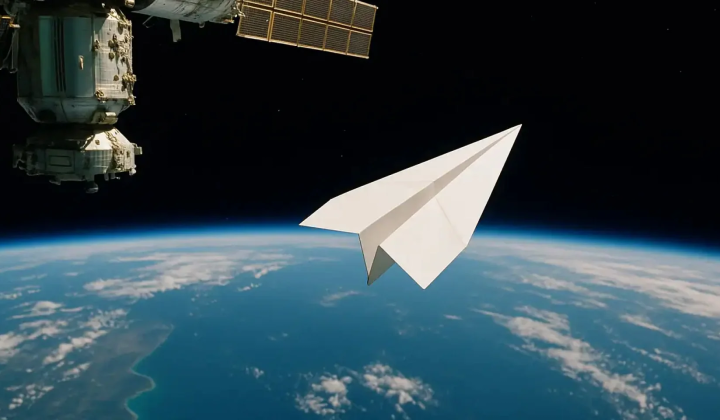
Origami in Outer Space
According to НВ — Техно: A paper aircraft weighing just 4 grams, made from cellulose and kaolinite, was released from an altitude of 400 kilometers in a study combining computer simulations and physical tests. Lacking any thermal protection, engine, or navigation system, the craft demonstrated static stability in the upper atmosphere but burned up upon entering denser atmospheric layers. This research offers practical insights for reducing space debris and could serve as a passive probe for measuring atmospheric density.
Researchers built a scaled-down origami model and placed it in the Kashiwa supersonic wind tunnel in Tokyo. The test lasted 7 seconds, with airflow reaching Mach 7-over one thousand meters per second. During the trial, the plane’s nose bent backward, forming a 3-millimeter fold, while the wing edges became charred. According to the study, reentry from a circular orbit at 400 km altitude takes several days, and they noted that ignition or pyrolysis is expected during atmospheric entry.
Space Debris and Aerodynamics
As of April 2026, the European Space Agency (ESA) reports roughly 45,780 tracked objects in orbit, along with over 1.2 million debris fragments measuring between 1 and 10 centimeters. The region between 200 and 300 kilometers above Earth remains one of the least explored. The concept of launching paper planes from the International Space Station (ISS) was first proposed in 2008. The unique experiments and data gathered from these tests could significantly advance our understanding of high-altitude aerodynamics.
The study authors noted that the paper space plane’s high sensitivity to aerodynamic drag allows it to function as a passive probe for measuring atmospheric density. These findings open new possibilities for further experiments in space technology.
Research on paper aircraft in space highlights the value of innovative approaches to tackling the growing problem of orbital debris, especially as satellite numbers increase. Lightweight, simple designs like paper planes could prove effective for studying the upper atmosphere and developing new methods for cleaning up space. This work paves the way for continued progress in aerodynamics and space technology research.

Read also