AI Workforce Analytics Market Projected to Hit $11 Billion by 2035

Forecasted Expansion of Workforce Predictive Analytics
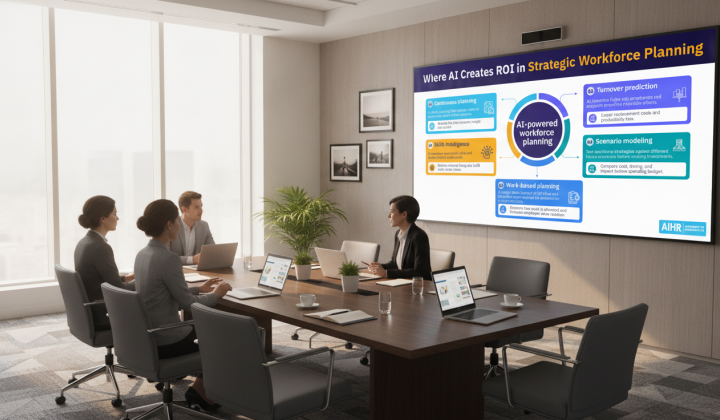
According to AIHR: The workforce predictive analytics market is expected to reach $11.2 billion by 2035. The return on investment (ROI) from artificial intelligence (AI) in strategic workforce planning will hinge on measurable improvements in costs, capacity, skill availability, speed, and risk reduction. High-value AI use cases include:
- forecasting critical skills,
- employee turnover,
- internal mobility,
- capacity planning,
- scenario modeling.
Corporate Adoption of AI
Major organizations such as Deloitte, IBM, and a healthcare network are leveraging AI to redesign roles and enhance workforce management. Deloitte Australia uses a job analysis tool that breaks down roles into specific tasks and activities. Meanwhile, IBM has compiled skill profiles for all 350,000 of its employees, with 80% confirming that their AI-generated skill profiles are 100% accurate.
A healthcare network comprising 14 hospitals deployed a skill-mapping solution for 23,000 workers during the COVID-19 pandemic. This initiative delivered significant results: the network saved approximately $31 million in temporary staffing costs and redeployed 2,847 employees into new roles within three weeks, retaining 97% of its workforce.
These examples illustrate how AI enables HR professionals to shift from annual planning cycles to continuous updates driven by real-time signals. Predicting turnover helps reduce replacement costs, while skill intelligence boosts internal mobility. Scenario modeling, in turn, allows organizations to stress-test workforce strategies-a critical capability in today's dynamic environment.
Integrating AI into strategic workforce planning can substantially improve organizational efficiency by lowering risks and optimizing expenses. The projected growth of the workforce predictive analytics market underscores the growing importance of these technologies for business development in the near future.
This trend highlights how technologies like AI are reshaping traditional approaches to human resource management. The increasing focus on workforce analytics reflects companies' efforts to adapt their strategies to a rapidly evolving labor market. Implementing such solutions can offer a competitive edge, enabling organizations not only to save money but also to manage resources effectively for better outcomes in changing conditions.
As companies increasingly recognize the importance of AI in workforce planning, it's noteworthy that only a small fraction have reached full maturity in its implementation. This gap highlights the challenges organizations face in leveraging predictive analytics effectively. To understand the barriers and opportunities in achieving AI maturity, explore how the current landscape reveals significant insights into corporate strategies and their impact on workforce management. Learn more about this disparity in our detailed analysis of AI maturity among businesses.

Read also