8 Billion Light-Years Out: Astronomers Detect Gamma Rays From Distant Blazar OP 313

A Gamma-Ray Breakthrough From Blazar OP 313
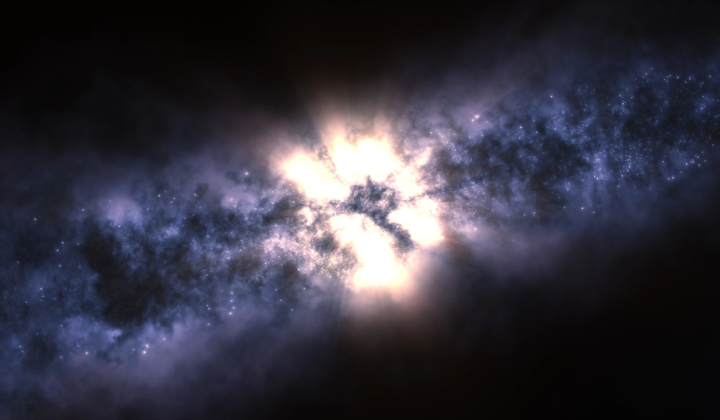
According to Radiotrek — Світ: Astronomers have picked up extremely high-energy gamma rays coming from OP 313, a blazar located nearly 8 billion light-years from our planet. The observations were made possible using the LST-1 telescope and the MAGIC system on La Palma, Spain. OP 313 now holds the record as the most distant blazar ever detected in this kind of gamma-ray light.
The signal left its source when the universe was roughly 3 billion years old. That means the detection opens a window onto the early cosmos and the extragalactic background light. For scientists, it is a rare chance to see what the universe looked like about 11 billion years ago.
Understanding What Powers OP 313
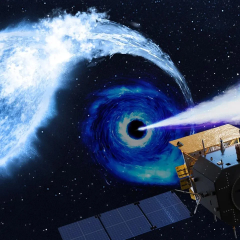
OP 313 is an active galaxy with a supermassive black hole at its core. It produces powerful particle jets, and one of those jets happens to be aimed straight at Earth. Particles inside the jet are accelerated to nearly the speed of light. As the gamma rays travel across space, they interact with extragalactic background light, which weakens them. This detection helps researchers understand black hole behavior, galaxy evolution, and conditions in the early universe.
The achievement is a significant milestone in astronomy, offering a deeper look into cosmic evolution and the workings of active galaxies. Studying objects such as OP 313 could guide future research into the structure and growth of the cosmos, as well as the nature of dark matter and dark energy.
In addition to the groundbreaking findings from OP 313, the cosmos offers other fascinating phenomena. For instance, a recent event highlighted a star being ripped apart by a wandering supermassive black hole, showcasing the dynamic and often violent interactions within galaxies. Exploring such occurrences can provide further insights into black holes and their role in the universe's evolution. To learn more about this captivating event, read about how a star was torn apart by a supermassive black hole at the edge of a galaxy.

Read also