Astronomers Identify a Neutrino Source 11 Billion Light-Years Away

Discovery of the Shadow Blaster Galaxy
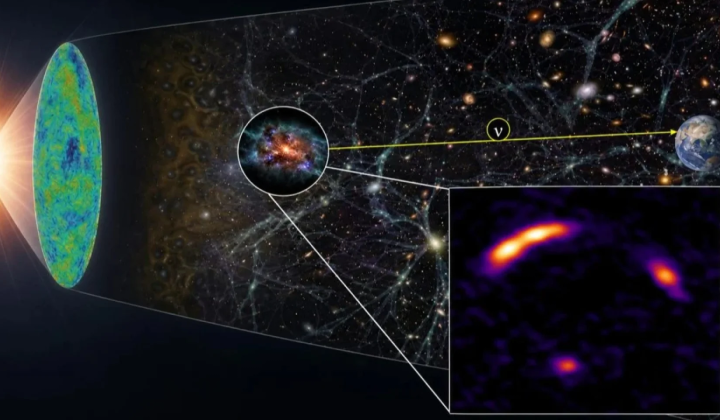
According to НВ — Техно: At the South Pole, the IceCube detector picked up a powerful neutrino flare labeled IC 210922A. To investigate this anomaly, an international team of astronomers directed the ALMA telescope in the Chilean Andes toward a suspicious patch of sky. Their observations revealed a galaxy designated JCMT0402-0424, nicknamed Shadow Blaster, located roughly 11 billion light-years from Earth.
Interestingly, the Shadow Blaster galaxy showed no signs of a supermassive black hole, which typically acts as a primary neutrino source. Instead, astronomers found an extraordinarily dense core spanning about 1,500 light-years, packed with enormous amounts of gas and dust. This environment is marked by intense star formation, suggesting new mechanisms for neutrino production in the universe.
Significance of the Research
Studies indicate that galaxies like Shadow Blaster could account for up to 20% of all high-energy neutrinos observed across the cosmos. Notably, another galaxy happened to lie between Earth and Shadow Blaster, acting as a gravitational lens-a coincidence that complicated the analysis.
The identification of the Shadow Blaster galaxy and its potential role in neutrino generation marks a major step forward in understanding cosmic processes.
This research opens fresh avenues for exploring not only neutrinos but also phenomena tied to star formation and galactic evolution. Grasping these mechanisms could help astronomers unlock the universe's mysteries and reveal new aspects of its structure and development.
This discovery aligns with recent findings in the field, particularly the identification of another galaxy that lacks dark matter. Such galaxies challenge existing theories about cosmic structures and their formation. To learn more about this intriguing development and its implications for our understanding of the universe, read about the third galaxy without dark matter.

Read also