A Linguist Explains the Curious Case of 'Blue' and Other Ukrainian Language Exceptions

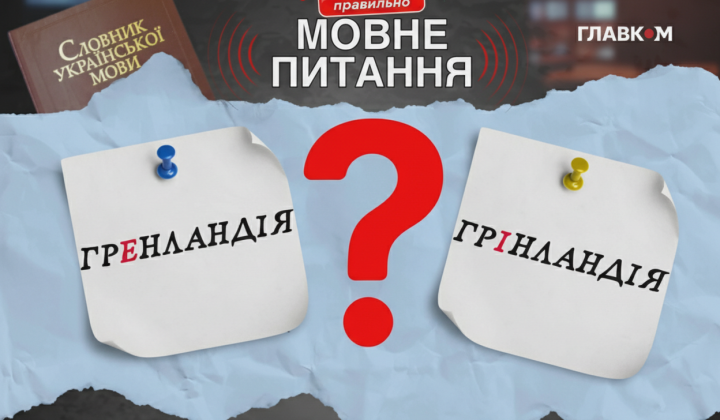
The Spelling of Greenland Explained
According to Главком: In a language column for the publication 'Glavcom', philologist Olha Vasylieva clarified the correct spelling of 'Greenland' and the usage of color adjectives. Readers had inquired why the name is written as 'Grenlandiia' and not in other possible ways.
Vasylieva explained that 'Grenlandiia' is a transliteration from the Danish 'Grønland'. In Ukrainian, the umlauted vowel 'ø' or 'ö' is rendered as an 'e'. This means the Ukrainian spelling is correct, while a version like 'Gronlandiia' would be wrong. A similar principle applies to the city of Cologne, originally 'Köln' in German, which becomes 'Keln' in Ukrainian.
The key point is that Greenland is transliterated not from English, but from Danish: Grønland. And in Ukrainian, we render the umlauts ø, ö as 'e': not 'Gronlandiia' as in the original, but 'Grenlandiia'; not 'Koln', but 'Keln'. So, the Russians have nothing to do with this case.
Olha Vasylieva
Color Adjectives in Ukrainian
Furthermore, Olha Vasylieva highlighted the usage of color adjectives. She noted that adjectives like 'green' (zelényi), 'yellow' (zhóvtyi), and 'red' (chervónyi) belong to a hard group, while 'blue' (synii) is soft. The soft group of adjectives also includes:
- relative adjectives (summer, rye, road-related),
- adjectives derived from adverbs (yesterday's, internal, near),
- adjectives with a stem ending in -й (boundless),
- adjectives with a possessive shade (brotherly).
Vasylieva emphasized that 'the soft group of adjectives within the color system is an exception.' Understanding these grammatical categories is essential for mastering Ukrainian, a language with a rich and complex inflectional system.
Thus, Olha Vasylieva's explanations provide greater insight into both the spelling of geographical names and the nuances of using color adjectives in Ukrainian. Her commentary helps readers avoid common mistakes and better navigate language rules. This is an important clarification that promotes linguistic literacy and the correct use of Ukrainian in everyday communication. In an era of globalization and the influence of other languages, such as English and Russian, knowledge of transliteration rules and grammatical subtleties is especially relevant for preserving linguistic identity.

Read also