Detection of Gamma Rays from the 8-Billion-Year-Old Blazar OP 313 Reaches Earth


Exploring the Universe’s Past: Scientists Study a Blazar Nearly 8 Billion Years Old
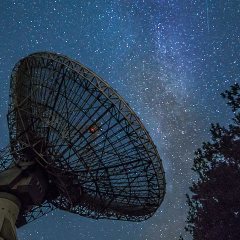
According to Radiotrek — Світ: Astronomers have successfully detected gamma-ray emissions from the distant blazar known as OP 313, which dates back approximately 8 billion years. This radiation is directed almost exactly towards Earth, offering a unique window into the conditions of the early universe. The initial observation occurred in December 2023 using the LST-1 and MAGIC telescopes located on the Canary Islands.
Insights into the Distant Blazar OP 313
OP 313 is classified as a blazar, an active galactic nucleus powered by a supermassive black hole at its core. This black hole emits jets of matter traveling near the speed of light, aligned almost perfectly with our line of sight. The gamma rays detected have journeyed across space for about 8 billion years, originating when the universe was roughly 5 billion years old.
This makes OP 313 the most distant blazar observed emitting high-energy gamma rays to date. Along their path, these gamma rays interacted with the light from stars and galaxies, causing some of the radiation to dissipate before reaching Earth. As described by an anonymous contributor, "the black hole draws in surrounding material, some of which forms powerful plasma jets."
Within these jets, particles accelerate to extreme speeds and interact with photons, producing the high-energy gamma radiation observed. These findings expand our understanding of cosmic phenomena and the universe’s evolutionary history.
Studying blazars like OP 313 is crucial for astronomy because it helps scientists unravel the universe’s development and the physical mechanisms at play. Analysis of gamma radiation from such remote sources provides valuable information about galaxy formation, black hole activity, and other astrophysical processes. This discovery also highlights the role of advanced technology in astronomy, as modern telescopes now enable the detection of signals from previously unreachable distances.
Ultimately, investigations into OP 313 promise to drive forward new breakthroughs in space science and deepen our knowledge of the cosmos.
In addition to the fascinating insights from OP 313, recent studies have also highlighted how powerful gamma-ray bursts can affect our planet. For instance, researchers have documented disturbances in Earth's ionosphere following the significant gamma-ray burst GRB 221009A. Understanding these phenomena not only sheds light on cosmic events but also illustrates the interconnectedness of the universe. To learn more about the implications of such bursts on our atmosphere, check out this detailed report on ionospheric changes following gamma-ray bursts.

Read also