Saber-Toothed Cats Were Unable to Shed Their Elongated Canines, Scientists Confirm

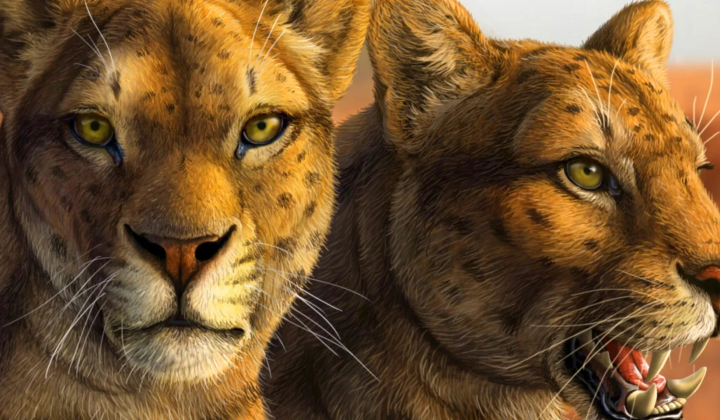
Discovery of Adelphailurus kansensis
According to НВ — Техно: A nearly complete skull belonging to an early saber-toothed cat has been identified from a fossil housed at the American Museum of Natural History in New York. The specimen, Adelphailurus kansensis, reinforces the idea that once hypercarnivores evolve elongated canines, they cannot reverse the trait. Paleontologists Nariman Chatar and Z. Jack Tseng from the University of California, Berkeley, explained that this machairodontine feline was roughly the size of a cougar. First described in 1934 based on a jaw fragment found in Kansas, the species has now yielded far more anatomical evidence.
The holotype originally consisted of left and right upper jaw bones with an almost complete set of teeth. Although Adelphailurus kansensis was initially identified from those jaw fragments, researchers in 1983 uncovered postcranial remains from the same local fauna in the museum's collections. The newly studied specimen includes a nearly intact skull, jaw fragments, and isolated upper canines that are flattened and serrated.
Evolutionary Processes and Adaptations
The narrow snout of Adelphailurus kansensis resembles that of the Eurasian Metailurus, while its rounded skull profile is similar to species in the genus Yoshi. The study suggests that during the late Miocene, predators moved between Eurasia and North America via the Bering land bridge. According to the researchers, the short upper canines found in ancestral saber-toothed forms-including Adelphailurus kansensis-support the theory that once these hypercarnivores began developing longer fangs, they could not revert to a less specialized state.
'We have never found a lineage that started developing long upper canines, then stopped and went back to a less specialized condition; once a group begins that path, the canines go wild, and then the animals go extinct.' - Dr. Chatar
Saber-toothed predators exemplify a phenomenon known as the macroevolutionary ratchet, where organisms evolve specific morphological traits that make them more efficient at certain tasks. However, when environmental conditions shift and make survival harder, these very adaptations can increase the likelihood of extinction. In light of these findings, it is also worth noting that a newly identified species, Paludocyon moyasolai, lived during the middle Miocene epoch, approximately 15.9 million years ago.
These results underscore the importance of studying predator evolution and their adaptations to changing environments. The discovery of Adelphailurus kansensis may offer fresh insights into the evolutionary processes that shaped the diversity of carnivorous mammals. The research also carries implications for understanding extinction mechanisms in the face of ecological change, a pressing topic in modern science.
As scientists continue to uncover fascinating details about ancient predators, recent discoveries highlight the evolutionary adaptations of various species. For instance, the recent findings of a new bear-dog species in Spain reveal significant insights into the diverse lineage of carnivorous mammals. These revelations not only deepen our understanding of predator evolution but also shed light on how different species adapted to their environments. To explore this intriguing discovery further, read more about the newly identified bear-dog fossils.

Read also